


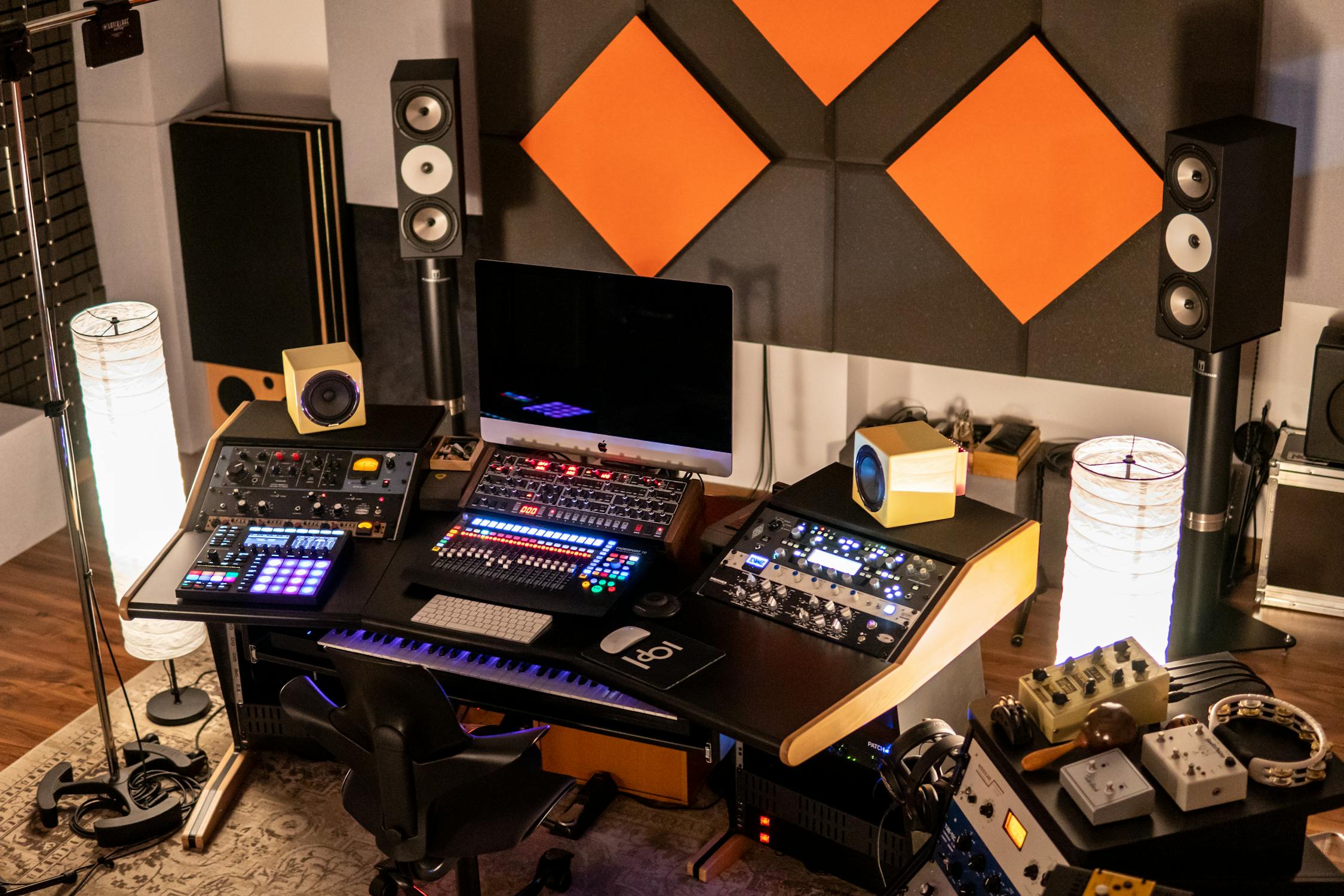
20 Jan Studio Monitors 2026: Honest Sound Starting at €200
▶ 4:44 Reading Time
You craft a beat – the bass feels thick, the hi-hats sit perfectly. You export it, send it to a friend – and they reply: “Sounds thin. Where’s the bass?” The problem isn’t your skills. It’s your speakers. Bluetooth speakers, gaming headsets, and laptop speakers lie to you. They make everything sound better than it is. Studio monitors do the opposite. They show you the truth. And that truth starts at €200.
Why Your Bluetooth Speaker Is Lying To You
Consumer speakers are engineered to make everything sound good. Bass is artificially boosted, highs are smoothed out, mids are pulled back. It’s comfortable listening – but if you produce music on them, you’re making decisions based on a lie. That “thick” bass? It’s not thick – it’s just being inflated by your speaker. Export your track and play it elsewhere, and the house of cards collapses.
Studio monitors do the exact opposite. Their frequency response is as linear as possible. What goes in comes out – untouched, unboosted, unmarketed. At first, it’s sobering. Some producers describe their first day with studio monitors as the moment they realized just how weak their previous beats truly were. But that’s precisely the point: you can only fix what you hear.

Under €300: Three Monitors That Are Enough
JBL 305P MKII (approx. €149 per pair)
Thomann and Amazon’s top-selling entry-level monitor. 5-inch woofer, 70 watts total output, frequency response down to 43 Hz. Its Image-Based Scaling Waveguide delivers wide, consistent stereo imaging – even when you’re not sitting exactly in the sweet spot. The safest starting point for bedroom producers.
PreSonus Eris E5 XT (approx. €240 per pair)
5.25-inch woofer, 80 watts, three room-EQ controls on the rear panel: Low Cut, Mid Filter, and High Filter. Adjust your monitor to your room – no external software needed. Ideal for producers working in small, untreated rooms who don’t want to hang acoustic panels.
Kali Audio LP-6 V2 (approx. €210 per pair)
The insider’s pick. A 6-inch woofer priced like a 5-inch model. Kali Audio built in a Boundary-EQ: four rear-panel switches let you calibrate the monitor depending on its proximity to walls – freestanding, in a corner, or flush against a wall. The monitor automatically adjusts its frequency response. For the price, nowhere else delivers more bass foundation.
From €300 Onward: When Honesty Isn’t Enough – You Want Precision
Yamaha HS5 (approx. €229 per pair)
The industry standard. White cone, black cabinet – found in nearly every second home studio worldwide for years. 5-inch woofer, 70 watts, frequency response down to 74 Hz (-3 dB). The HS5s aren’t the most exciting monitors – they’re the most honest. If a mix sounds good on the HS5s, it’ll sound good everywhere. That’s their sole purpose – and they’ve delivered it flawlessly for over a decade.
Adam Audio T5V (approx. €300 per pair)
The Berlin insider’s tip that’s no longer a secret. Its standout feature: the X-ART tweeter. A ribbon tweeter that reproduces high frequencies with an airiness and detail unmatched at this price. Hi-hats, vocals, reverb tails – you hear them with a clarity that’s addictive. Producers of electronic music who work heavily in the upper frequencies will find themselves better served here than with Yamaha.
Focal Alpha 50 Evo (approx. €375 per pair)
French engineering excellence. Its Slatefiber diaphragm, a proprietary carbon-fiber composite, is stiffer and lighter than conventional materials. Result: fewer self-resonances, tighter, more precise bass. A frequency response down to 45 Hz from a 5-inch woofer is remarkable. For producers torn between Yamaha and Adam, Focal offers the golden middle ground. Anyone who wants to understand how bass really works hears it clearly on these monitors.
Studio monitors reveal the truth about your music. At first, it’s painful. Long-term, it’s the most valuable thing you’ll ever buy.
5 Inch, 7 Inch, or 8 Inch: Which Size Fits?
Woofer size determines how low a monitor can reproduce bass. Bigger means deeper – but also more challenges in small rooms.
5 inch is the sweet spot for rooms up to 15 square meters. Sufficient bass for most genres, minimal room issues, affordable price. Most beginner setups land here.
7 inch delivers richer bass detail and suits rooms of 15-25 square meters. The Adam Audio T7V (approx. €340 per pair) shares the same X-ART tweeter as the T5V – but with noticeably deeper foundation.
8 inch makes sense only if your room is large enough and acoustically treated. In an untreated 10-square-meter room, an 8-inch woofer creates standing waves that artificially inflate your bass. You’ll hear too much bass, over-compensate while mixing – and your track will sound thin everywhere else.
Your Room Matters More Than Your Monitor
The uncomfortable truth: a €200 monitor in an acoustically treated room delivers more reliable results than a €1,000 monitor without room correction. Your room alters everything you hear.
Three immediate fixes:
Absorbers at first reflection points. Sit at your workstation and have someone slide a mirror along the side wall. Where you see your monitor reflected in the mirror – that’s your first reflection point. Place an acoustic absorber there.
Bass traps in room corners. Low frequencies accumulate in corners. Foam corner traps starting at €50 noticeably improve bass response.
Position monitors at ear level, forming an isosceles triangle. The tweeter should point directly at your ears. Distance between monitors and distance from each monitor to your head should be equal.
- You produce beats, songs, or podcasts – and need honest feedback
- Your mixes never sound the same on other systems as they do at home
- You’re ready to hear the unvarnished truth about your sound
- You only want to listen to music – not produce (then hi-fi speakers are better)
- You lack desk space for two separate speakers
- You live with neighbors who won’t tolerate loud bass
Q&A After the Show
Click any question to expand its answer.
Do I need an external amplifier for studio monitors?
Can I use studio monitors for casual music listening?
Why do my monitors hum when nothing’s playing?
Is a subwoofer worth adding to an entry-level monitor?
Cover image: Pexels / Andreu Marquès
Translated from the German original using artificial intelligence. The German version is authoritative.
