


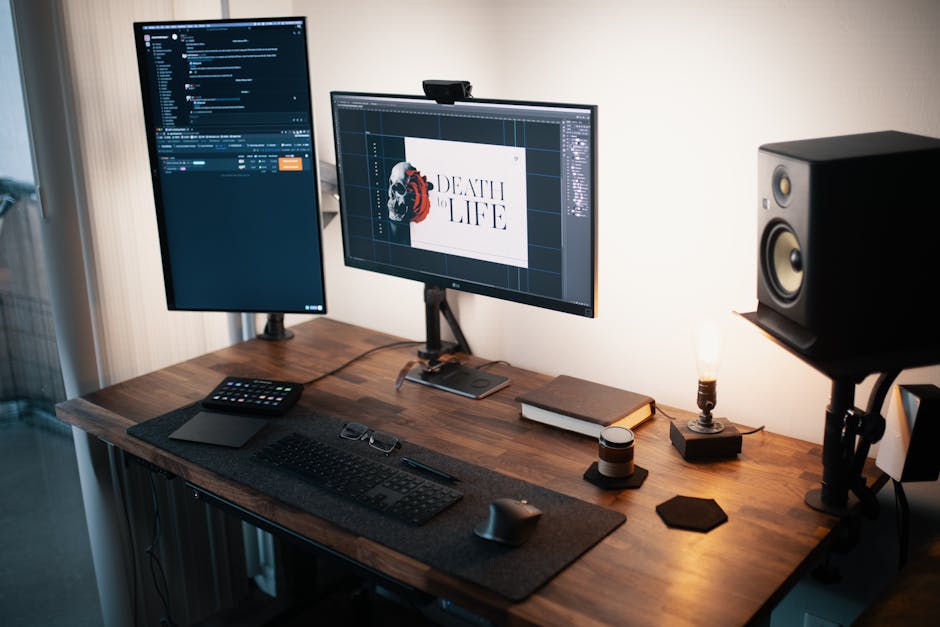
13 Apr PC Speakers Under €400: 2026 Active Box Test for the Desk
▶ 6:54 read time · Updated: April 2026
Those Logitech plastic speakers on your desk hail from an era when a PC was just a device to launch games, and music played casually from a browser tab. That era is over. Today, if you spend your days in front of a monitor, you’re listening to music, taking calls, and streaming content. Active speakers in the sub-400 Euro class have leveled up so dramatically in the past two years that they now rival what bookshelf speakers with external amps once delivered. I’ve auditioned six models—five make the cut, and one gets the boot for busting the budget.
Why desktop active speakers are now in a league of their own
Three things have changed in the last two or three years. Class-D amplifiers have become so small and efficient that a proper power stage now fits into a cabinet that once barely housed a passive woofer. USB DACs with 24-bit resolution are no longer a premium feature—they’re standard. And Bluetooth codecs like aptX-HD and LDAC have closed the gap to wired connections so effectively that most users can’t hear the difference in everyday use.
That shifts the question entirely. It used to be: small active speakers for your desk or a pair of bookshelf speakers with a separate amp? Now, it’s: which of the ten serious active speakers under 400 Euro fits your setup? The upgrade isn’t about moving up a tier—it’s about making the right choice. And that changes how you approach the buying decision. Specs matter, but not the way marketing spins them.
What really matters when your speakers sit on your desk
Four things matter more than wattage figures or frequency response curves that look identical in every marketing sheet. First: a USB input that bypasses your computer’s built-in DAC. Onboard sound chips are fine for calls, not for music. Second: Bluetooth with aptX, AAC, or LDAC. SBC is the default—and sounds like it. Third: physical controls on the device itself. If you’re clicking through your OS three times an hour to adjust volume because your speakers lack a knob, you’ll banish them from your setup within three weeks. Fourth: standby power draw under one watt. You don’t hard-power them off every night.
What doesn’t matter: nominal wattage ratings. A 60-watt RMS active speaker per channel has more than enough headroom for calls and music in a 12-square-meter office—right up to your roommates’ pain threshold. What does matter: how they sound at normal desk volume. That’s something no spec sheet can tell you; you’ll need to listen or rely on trusted reviews.
What is an active speaker? A speaker system with a built-in amplifier, often including a DAC and Bluetooth. Unlike passive speakers, you don’t need a separate receiver or amp. Active speakers are the go-to solution for desks—they save space, simplify cabling, and can be acoustically matched to their amplifier.
Audioengine A2+ Wireless: the classic that’s aged honestly
The Audioengine A2+ Wireless has topped every desktop active speaker recommendation list for years. Currently available from around €281 at German retailers. It’s compact—often a dealbreaker on a desk. It packs aptX-HD Bluetooth, a USB DAC, and a sub-out for future upgrades. Sonically, it leans into warm mids and a subtle bass boost, which works well for background music but can be distracting when mixing. If you’re not planning to add a subwoofer, you won’t hit its upper volume limit at your desk because it lacks low-end reserves. Build quality is solid, with a wooden cabinet and sensible rear connections. The US heritage shines through in its design.
- your desk is on the small side
- you frequently switch to Bluetooth from your smartphone
- warm, inviting sound matters more than studio neutrality
- you produce or mix music
- you want low-end bass without a subwoofer
- USB-C is a must over USB-B
Kanto ORA4: built for the desktop, not the shelf
The Kanto ORA4 was designed from the ground up as a desktop speaker—not a shrunken bookshelf model. Currently available from around €381. What that means in practice: a USB-C input for bit-perfect 24-bit playback, integrated DSP to smooth out nearfield standing waves, and included stands to position tweeters at ear level. A 140-watt DSP-tuned Class D amp. Bluetooth 5.0 with AAC. Sonically, it’s more neutral than the Audioengine, less immediately appealing but more honest over long sessions. The cabinet blends seamlessly into a tidy setup, though its minimalist look won’t be for everyone.
- you want USB-C without adapters
- you work long hours in the nearfield and want to minimize fatigue
- you prefer modern, clean-line aesthetics
- warm sound is your default preference
- you don’t want DSP interference
- €350+ feels too steep
Edifier S2000MKIII: The Value-for-Money Case
The Edifier S2000MKIII is the reason it’s almost rude to talk about active speakers under 400 Euro without mentioning Edifier. Currently available from around 328 Euro—well over 100 Euro below its original list price. 130 watts Class-D, planar magnetic tweeter, optical and coaxial inputs, Bluetooth with aptX-HD, and a solid wood cabinet with honest craftsmanship. It’s larger than the other models here. That’s the trade-off. But if you give it the space, you get sound that rivals models in the next price bracket for depth and resolution. Bass holds its own without a sub, and highs never turn harsh. A remote is included.
- you have space for larger speakers
- sound-per-Euro matters more than footprint
- you want a full-featured active speaker for desk or shelf
- your desk is under 120 cm wide
- you expect a USB DAC in the box (the S2000 doesn’t have one)
- you prefer modern industrial design
Edifier S1000MKII: The Little Brother with Big Ambitions
The S1000MKII is the slightly smaller sibling in the S2000 series, currently priced at around 259 Euro. 120 watts, aptX-HD Bluetooth, optical and coaxial inputs, and a Class-D amp. Sonically, it strikes a balance between Audioengine’s warmth and the S2000’s resolution. If you can’t stretch to the S2000’s price or don’t have the space, this model delivers most of Edifier’s strengths for noticeably less money. The only minor drawback? No built-in USB DAC. If you connect your computer via RCA or optical, it’s a complete solution. If you need USB, you’ll either pay more (for the S2000) or add an external DAC.
- your budget maxes out at 250 Euro
- you can connect via optical or RCA
- you want Edifier sound without the S2000 premium
- you need a USB DAC without workarounds
- you want planar magnetic tweeters (S2000 only)
In a pro-audio context, this logic is easy to distill: if you’re mixing in the studio, you want studio monitors. If you’re enjoying music or taking calls at your desk, you can borrow from the HiFi shelf. Both are valid—both sound different.
Presonus Eris E4.5: Honest studio sound at a desktop price
The Presonus Eris E4.5 is a studio monitor—not a HiFi speaker. Currently available from around €199 for the pair. It packs a Class-AB amp with 50 watts, a 4.5-inch Kevlar woofer, and built-in EQ controls on the rear. What “studio monitor” means: no sound enhancement, no boosted bass, no smoothed-out highs. You hear exactly what’s in the mix. In everyday use, that takes some getting used to. Some pop productions sound less polished on studio monitors than on HiFi speakers because they reveal the minor flaws that HiFi sound glosses over. Once you appreciate that honesty, there’s no going back. If that’s not what you’re after, you’ll be happier with an Edifier S1000MKII.
- you produce, mix, or podcast
- you prioritise neutral sound over pleasing sound
- your budget is under €200
- you prefer HiFi sound with boosted bass
- you only listen to music, not produce it
- Bluetooth is a must (BT version costs extra)
Which one for which use case
If your setup is a 14-inch laptop on a standing desk with music playing in the background, go for the Audioengine A2+. If you work at a 27-inch monitor for six hours a day and want fatigue-free sound, the Kanto ORA4 is the pick. If you have the space and want the best overall sound quality per euro, the Edifier S2000MKIII is the way to go. On a tighter budget? The smaller S1000MKII covers 80% of needs. And if you evaluate audio honestly rather than just listening, the Presonus Eris E4.5 is your match.
Setup tips that beat your next upgrade
Three things that often make a bigger difference to sound than jumping up a price bracket. First: positioning. Align tweeters at ear level, keep at least 30 centimetres from the rear wall if possible, and angle slightly toward your listening spot. Stands or foam pads to reduce resonance help more than most expect. Second: source. Onboard sound is mediocre. Even a budget €80 USB DAC elevates the Bluetooth chain above what most laptops deliver internally. Third: streaming quality. Spotify Free streams at 96 kbit/s. Apple Music and Tidal offer lossless at no extra cost. If you invest in active speakers but still use SBC Bluetooth with Spotify Free, you’re optimising the wrong link in the chain.
Playlist for Your First Listen
Four tracks that sound dramatically different on proper active speakers than they do through your laptop’s built-in ones. Bonobo’s track reveals what depth layering does to a stereo image. Tycho delivers clean synth bass without muddiness. Nils Frahm tests whether tweeters stay true during piano attacks or start to distort. And Floating Points shows how much detail in the upper mids gets lost when your speakers can’t keep up.
Post-Show Q&A
Click on a question to reveal the answer.
Do I need an external DAC for these speakers?
Soundbar or active speakers at your desk?
Is aptX-HD really worth it over AAC?
Do I need a subwoofer?
Are these speakers good for gaming?

Soundbar vs. stereo under 500 Euro: Which sounds better? →
What is a DAC and do you really need one? →
Bluetooth codecs explained: aptX, LDAC, LC3 →
Beyerdynamic DT 900 Pro X: The producer’s headphones →
Hi-res audio: Can you really hear the difference? →
Source image: Pexels / Josh Sorenson (px:7899236)
Translated from the German original using artificial intelligence. The German version is authoritative.