

11 May Techno 2026: Modular, AI, Stream in Comparison
5 Min. Read Time
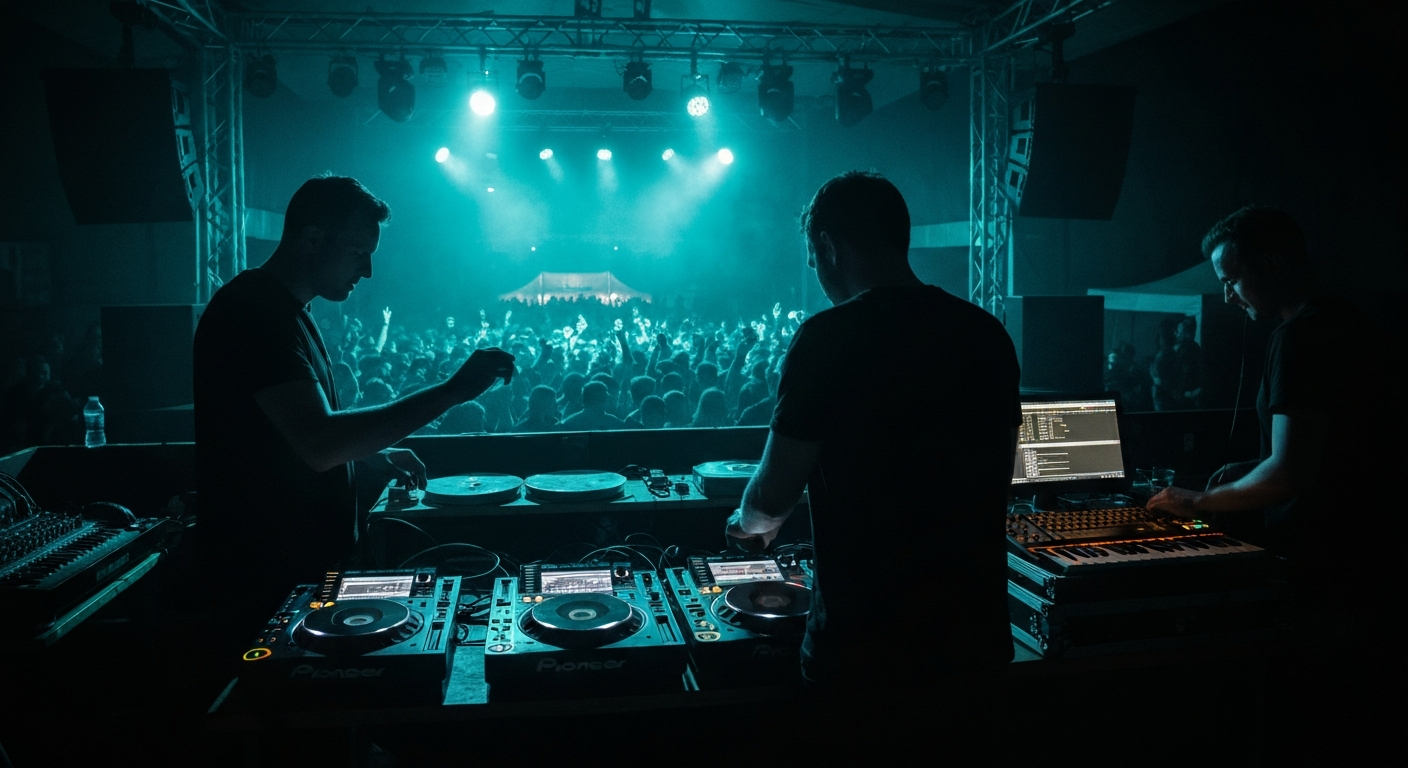
Three weekends at Berghain, three different sets, three different machine setups. On one, a modular patch system stood out, looking like Behringer Crave and Mutable modules. On another, a KI tool ran in the background, mixing transitions. On the third, no laptops were visible, just hardware. The techno scene in 2026 no longer has a uniform answer to what technology should do. It has three parallel answers. And they contradict each other.
11.05.2026
Modular synths are back, and they’re affordable
In March, I attended the modular synth meetup at the Funkhaus in Berlin. What was once a hobby for IT consultants with dual-income households in 2018 has become a viable tool by 2026. Behringer has driven down the cost of the Crave series to under 200 Euros per module, while Mutable Instruments, as an open-source supplier, has set the market standard. Doepfer continues to build solid A-100 systems as the go-to option. A fully functional patch system starts at 1,500 Euros – a stark contrast to the past, when a single Moog Voyager cost that much just to get started.
In clubs, DJs are playing fewer tracks and more extended, modular setups. A set becomes a performance, with patches evolving over hours. This marks a sonic departure from the Ableton Live generation, as there’s less reliance on loop recall and more emphasis on real-time sound design. At the Tresor in early April, I heard a three-hour set using a single Eurorack, with no file drops and no laptop backups – everything was created live on the patch.
“The modular comeback isn’t about nostalgia. It’s a response to the saturation of laptop DJs. When every set sounds the same because everyone uses the same stems, hardware becomes the tool for differentiation.”
– Andrea Trostel, modular resident at Berghain Säule, interviewed by Groove Magazine in February 2026
AI tools are part of the setup, whether you like it or not
Running parallel to this trend is another stream moving in the opposite direction. Algoriddim Djay Pro AI released stem separation in live performance quality in 2025. You drop a track in, and the software separates drums, vocals, bass, and synths in real-time. Live mash-ups become technically trivial. Endlesss Studio provides AI-generated loops that adapt rhythmically and harmonically to your set. If you’re playing in F minor at 138 BPM, the response comes in F minor at 138 BPM, perfectly in sync.
Observations from three clubs reveal that most DJs use AI as a safety net, not as their primary tool. Those who take risks and experiment have a stem detector running in the background, just in case a transition fails. However, few openly embrace AI as a performance element. There’s an honesty issue in the scene that no one openly addresses.
Stream Clubs are Becoming Their Own Format
What was driven by the pandemic in 2020 will become a standalone performance format in 2026. HÖR Berlin now has a reach that competes with Beatport-Charts acts. Twitch DJ channels like those of Anfisa Letyago or Hector Oaks attract between 50,000 and 300,000 live viewers per set. Boiler Room has been leading the way for years, but 2026 will see smaller platforms catching up in a big way.
The technical stack has professionalized. Multicam live switching, lighting programming specifically for stream optics, and dedicated audio engineers for the stream mix alongside the floor mix are now standard. This is no longer a garage show. And it’s changing who gets booked as top acts: DJs with streaming reach are booking better than those with just underground credibility.
For those looking to move from theory to practice, our Sample-Clearing Guide for KI-Detection Tools is a must-read. The legal side of the KI hype is precisely what this producer generation is facing.
What Fragmentation Means
When three streams run in parallel – modular, KI-augmented, and stream-native – the scene no longer agrees on what authenticity means. In 2018, everyone knew a DJ stood behind two Pioneer decks and a mixer. By 2026, the same set could be three different technical setups without an outsider noticing the difference.
This isn’t inherently bad. It means the scene debate about “right” and “wrong” technology becomes irresolvable. The DJ using modular hardware isn’t more honest than the one mixing with KI – they’ve just chosen a different tool. And the DJ streaming on Twitch isn’t any less underground than the one playing in a 200-person club – they’ve just chosen a different reach.
What remains is the performance itself. A good set is recognizable no matter the hardware. A bad set won’t be saved by KI or improved by modular gear. Technology in 2026 is a tool, not a statement.
Playlist to Listen to
Four tracks that showcase the three distinct sounds expected in 2026. Plastikman represents the modular hardware lineage. Dettmann/Klock embodies the classic Berghain hardware sound, which remains a reference today. Daniel Avery highlights the UK hybrid variant.
Plastikman – Spastik (Modular Classic, Acid Lineage for Today’s Patch Comeback)
▶ Spotify
Marcel Dettmann & Ben Klock – Phantom Studies (Berghain Sound, Classic Hardware Studio)
▶ Spotify
Marcel Dettmann & Ben Klock – Dawning (Ostgut-Ton Classic, Tension Without Laptop)
▶ Spotify
Daniel Avery – Drone Logic (UK Hybrid Approach Between Live Hardware and Sequencer)
▶ Spotify
Post-show Q&A
Click on a question to reveal the answer.
Is Modular worth it for a beginner?
Is AI stem separation in live sets ethical?
Are all underground acts streaming their sets now?
Does technology really change what Techno sounds like?

Editor, IBS Publishing ››
Sample-Clearing: AI Tools Transform Indie Production →
Vinyl 2026: The Comeback of the Billion-Dollar Record →
Studio Monitors vs. Headphones for Producers 2026 →
AI Music 2026: Suno, Udio, and the Indie Scene →
Songs Under Two Minutes: Charts 2026 →
Image source: AI-generated (May 2026), C2PA certificate embedded in image
Translated from the German original using artificial intelligence. The German version is authoritative.