


14 May Berlin Club Crisis: Pop-up Spaces and the Wilde Renate
▶ 5:40 min read · Scene Report
The Watergate has been closed since New Year’s Eve. Wilde Renate shut its doors at the end of 2025 after eighteen years. While landlords and city council point fingers at each other, a few streets away a club opens its doors—one that used to be a warehouse.
The new space has no name and announces its opening hours via Telegram. Both are happening in 2026. Both are clubs. The question is what the two have in common.
What Actually Happens When a Club Closes
Watergate, Wilde Renate, About Blank, Loophole, Burg-Schnabel-Club. The list of Berlin closures over the past twelve months reads like a generational timeline. Each club symbolizes a phase, a sound, a crew. When Wilde Renate shut its doors at the end of 2025, it wasn’t just a venue that disappeared—it was a layer of memory. Anyone who stood at its door in 2008, got married there in 2015, or simply spent countless nights inside carries a void in their mental map of the city.
The reasons are mundane and inseparable. Rents up 60 percent in five years. Soundproofing mandates under the tightened Federal Immission Control Act now require 35 decibels at night in residential areas. Staff costs up 22 percent. Energy bills up 40 percent. What was once a local niche headache has become a spreadsheet reality where every free bouncer hour is a cost that never turns into revenue.
What you see as a guest: fewer choices. What you see as a promoter: less willingness from landlords to take risks, fewer insurers willing to cover venues, and less appetite for locations with deep roots in the community.
What makes the new spaces different
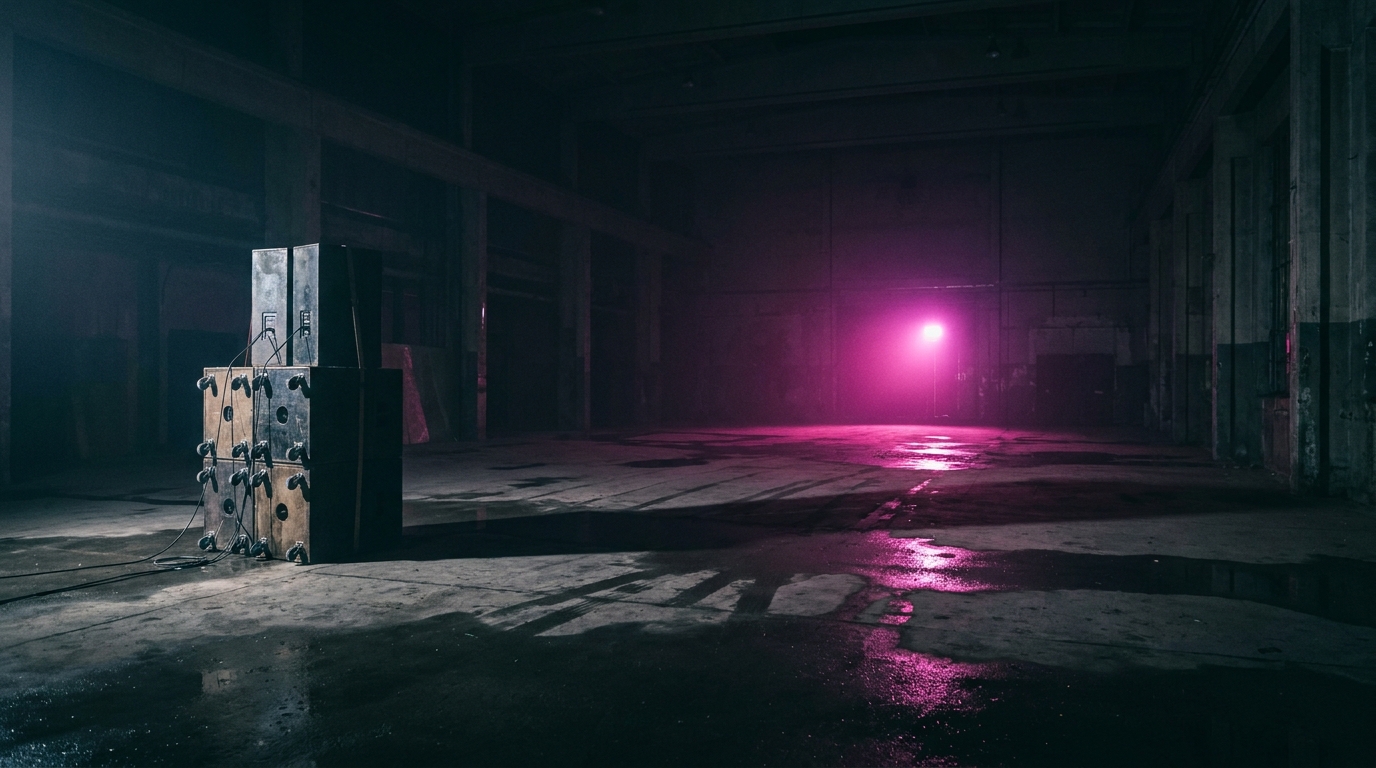
Visit a former paint shop in an industrial park two S-Bahn stops beyond the ring on a Saturday at 2 p.m. The organiser rents the hall for 36 hours, set-up until Sunday morning. Soundproofing isn’t an issue because the only neighbours are workshops. Approval comes via a one-off event notification under Section 60a of the building code. Tickets are sold only through a closed Telegram channel. The stage is DIY, the DJ booth a wooden plank on beer crates. Entry is 18 Euro, of which 4 Euro goes to a relief fund for shuttered clubs.
Sounds precarious. It is. Yet it works. Eight hundred people show up, nobody complains, the police cruise by twice and drive on. By Sunday evening everything is gone. The hall stands empty again. The next event takes place three weeks later in the backyard of an old print shop, different concept, different crew.
That’s a different logic. The logic is recurrence instead of permanence. Movement of places instead of a fixed address. In the 2010s, club founders relied on substance. Today’s generation relies on choreography.
What both have in common
- Sound system tuned for seven years, every square metre acoustically optimised
- Experienced staff with responsibility, on-call awareness team
- Booking and door system that balances conflicts
- Reliability: open every Friday and Saturday
- Low threshold, low rent, low risk of sanctions
- Sound concept redesigned for each event, so more experimental
- Curated guests via Telegram, fewer tourists, more community
- No expectation of permanence, so easier to dissolve without drama
What links them both: they want to create the same state—dance and loss of time, an hour when you don’t care what you’ll do next. Legacy clubs achieve it through routine, the building, and the acoustic shell. Temporary spaces achieve it through scarcity and conspiracy. You don’t go because it’s every Saturday; you go because it’s this one Saturday.
Where the pop-up model hits its limits
Awareness work fares worse with an untrained crew. When a conflict escalates at 3 a.m., you need staff who’ve survived ten such nights. Awareness teams who’ve spent a weekend together in the same room and know one another. In the pop-up world, those teams must be reassembled every Saturday, reoriented from scratch. That’s a real shortcoming.
Musically, you also lose programming depth. Running a club for three years lets you cultivate resident DJs who grow into your sound system. In the pop-up model you’re stuck with guest sets that lack the same connection to the room.
Third, pop-ups only work for the crowd inside the Telegram channel. An 18-year-old new to town has no access. The legacy club with a fixed address was an open door for everyone. That’s partly gone.
Why the debate over club closures is misguided
The call to protect cultural spaces for clubs is justified. But the argument that club culture cannot exist without fixed venues is wrong. Moving from place to place is itself a form of culture, with its own logic, its own aesthetics. What it needs is not preservation of the past, but adaptation of regulations: approval processes for temporary events that don’t last twelve weeks, insurance packages for weekend operators, and noise protection rules that differentiate between residential areas and industrial wastelands.
Urban policy still treats clubs like theaters: fixed venues, fixed seasons, fixed line-ups. But clubs are closer to festivals or sporting events—dynamic, short-term, locally specific. Wanting to save Wilde Renate is a sympathetic reflex, but you’re saving a business model that can’t survive without subsidies. Legalizing new spaces enables a different model, one that’s economically viable because it carries fewer fixed costs.
What remains
Renate is gone, the Halle in Adlershof is closed. Both packed 800 people into dancing on the same night. Both gave someone the feeling that this city still makes sense. One form fades, another rises. Mourning club closures is valid. Celebrating new beginnings is too. It’s the same phenomenon seen from two sides. You can mourn—and still head out to some unfamiliar hall next Saturday.
Playlist to listen to
Five tracks from the Berlin scene 2024–26 that capture the tension between substance and motion. Resident material from closed clubs and pop-up venues.
Q&Amp;A After the Show
Click on a question to reveal the answer.
Why are so many Berlin clubs closing at the same time?
Are pop-up spaces legal?
How do I get into the closed Telegram channels?
Are clubs dying in other cities too?
Image source: AI-generated (May 2026), C2PA certificate embedded in image
Translated from the German original using artificial intelligence. The German version is authoritative.