


19 Jun Field Recording for Producers: How to Build Your Own Sounds from Everyday Noises
6:00 Read Time
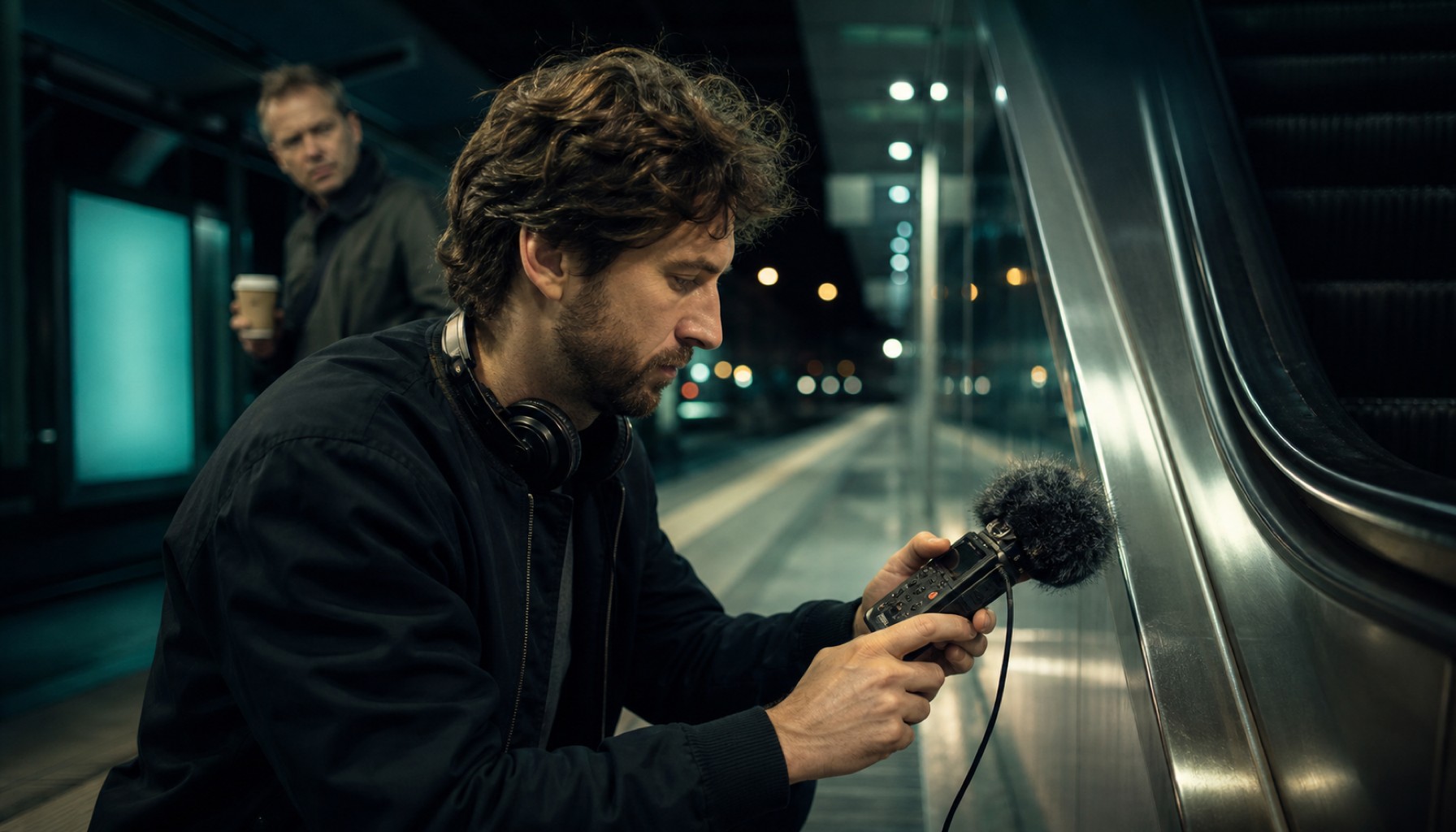
It’s just after six on a Tuesday morning, the S-Bahn station is still almost empty, and I’m holding a 200-Euro recorder up to an escalator that’s been humming the same metallic tune for minutes. A man with a coffee cup looks annoyed. I still take two minutes of recording. Three days later, this hum has become the bass drum layer of a track that no sample pack in the world could have sold me. That’s exactly what Field Recording is about: not perfect recordings, but sounds that no one else has.
What You Hear After 10 Minutes with the Recorder
Field recording means capturing the real world and turning it into raw material for your own tracks. The first step doesn’t happen in the DAW, but in your head. After ten minutes with headphones, you start to hear things that would otherwise get lost in the city noise: the click of a turnstile, the hiss of a coffee machine, rain on a metal roof that sounds harder and grittier than rain on asphalt. Field recording is primarily an exercise in listening – and no plugin collection can replace that.
My first usable material didn’t come from a spectacular moment, but from the backyard: an old garage door that resonates deeply when closed, almost like a disgruntled 808. Recorded with a Zoom handheld, two meters away, levels just below clipping. This distance often makes more of a difference than the price of the device. Too close, and you only capture a drone. Too far, and the space eats away the character.
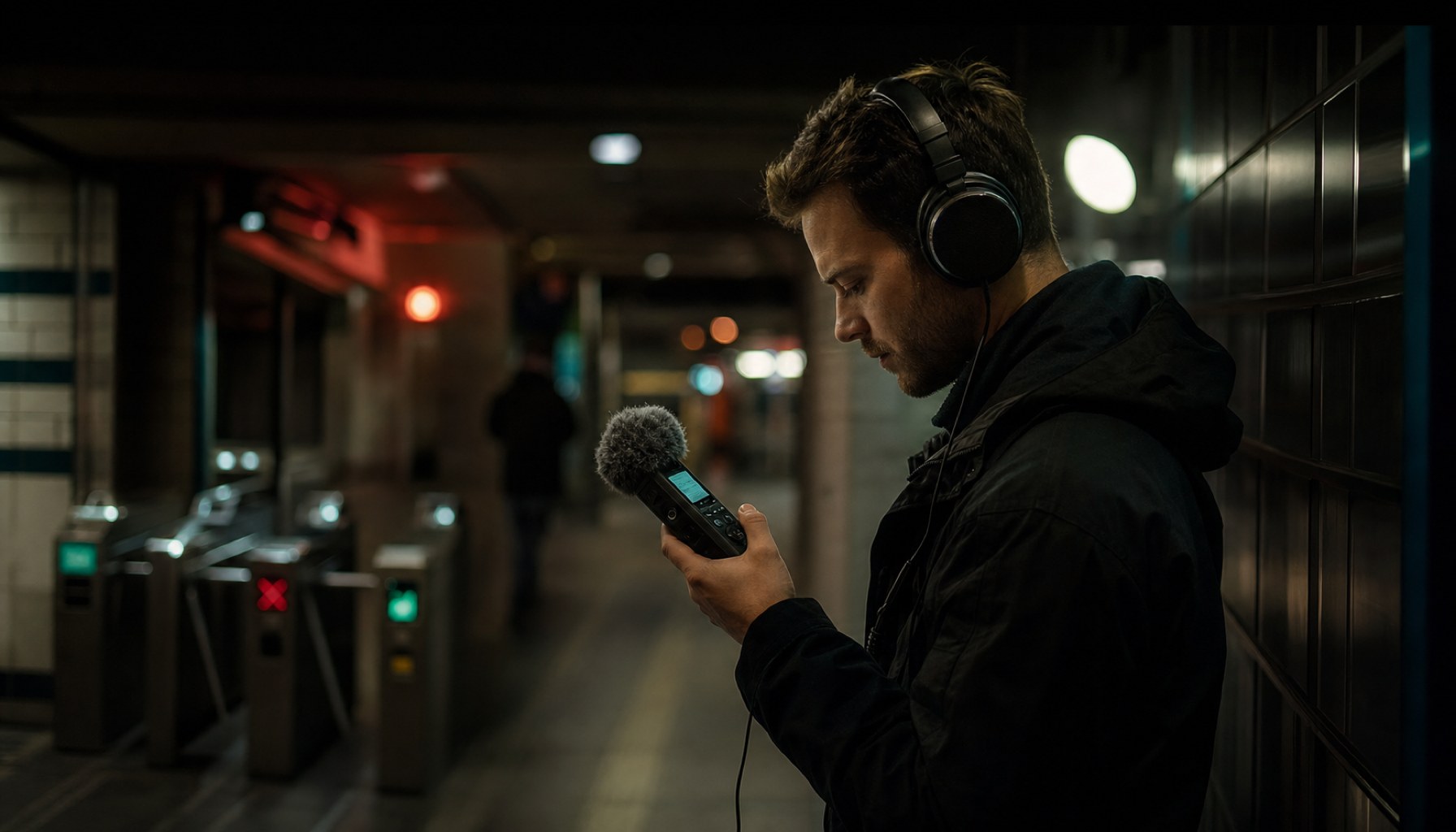
Technically, you need less than many producers think. A handheld recorder from the Zoom H- or Tascam series costs roughly between 100 and 250 Euros; a good smartphone with a WAV app will also do for starters. More important than the logo on the device are three things: a windscreen, headphones, and a clean level. Wind ruins takes, and clipping can’t be fixed.
Why Found Sound Carries More Weight than a Sample Pack
Sample packs have a simple problem: if you find a sound in one, thousands of others have it too. Field recordings, on the other hand, carry traces that can’t be cleanly replicated: a brief gust of air in the microphone, the space behind the noise, a metallic tone that fades out slightly off-key. Anyone who’s ever understood how a synthesizer builds sound from scratch knows how clean and predictable oscillators can be. Found sound brings friction back into the mix.
From raw material to finished sound, the path is almost always the same: first, collect; then, heavily sort; then, alienate in the DAW. If you follow this process cleanly, you’ll find the two seconds that become a genuine track element faster.
Recording
At least 48 kHz, preferably 96 kHz, always as WAV. A high sample rate gives you room to pitch the sound down extremely later without it breaking.
Review and Cut
Most recordings are 90 percent unusable. You’re looking for the two seconds that have character, and you throw the rest away.
Processing
Pitch, time-stretch, granular synthesis, and filter. A pitched-down garage door becomes a kick; a stretched hiss becomes a pad. Here, it’s decided whether the take remains just a noise or gets a function in the track.
Implementation
As a layer under drums or pads, subtly mixed. Found sound works best when you don’t consciously hear it, but just feel that the track is alive.
For my garage door, it was simple. From the two usable seconds, I first isolated just the deep attack, then pitched it down two octaves and cut everything above 200 Hertz with a low-pass filter. What remained was a short, rough impulse that lies as a layer under a normal kick and gives it a weight that no drum sample can bring. No one in the audience would ever guess it was a garage door, and that’s the point: the origin disappears, the character remains.
Once you’ve implemented the sound, the same rules apply as for any other element in the mix. A clean level build-up determines whether the layer carries or just creates mush, and that’s exactly where the fundamentals from arranging from loop to finished track help.
How Your Sound Library Takes Shape from Raw Material
The greatest benefit doesn’t come from a single track, but from building your own library. If you consistently record and sort for a year, you’ll eventually have a collection that no one can replicate. Name each file properly, tag it by material and character, and you’ll find the right sound in seconds, not hours.
A word on the legal situation, because it’s often forgotten. Public noises in the city space are no problem, but as soon as you record foreign voices, background music, or clearly recognizable private situations, you need permission. In case of doubt, leave the spot out. There are enough sounds that belong to no one. And the rest is patience: The best recordings are made early in the morning or late at night, when the city loses its background noise and individual sounds suddenly gain space.
Q&A after the Show
Click on a question to expand the answer.
What recording device do I need to get started?
What sample rate should I use for recording?
Can I record everything outside without restrictions?
How do I turn a recording into a usable sound?

Image source: Title image and article images AI-generated (June 2026), C2PA certificate embedded in the image
Translated from the German original using artificial intelligence. The German version is authoritative.