


19 Jun EDM Beats 2026: Four Rhythms That Will Dominate the Charts
6:00 reading time
Go into a club, listen for 20 minutes and you’ll spot 2026 four beats sharing the dance floor: the straight House pulse, the stumbling Garage shuffle, the percussive Afro‑House groove and the deep Log‑drum from Amapiano. They sound different but sit on the same tiny toolbox: Kick, Clap, Hats, Shaker. What matters isn’t the pricey plug‑in, but the spot in the grid where each hit lands.
Why four grooves share the floor in 2026
An EDM beat consists of a kick, snare or clap and hi‑hats over four beats of a bar. Sounds simple, but it decides everything. In 2026 no single sound dominates any longer. Four very different grooves run simultaneously through playlists, club sets and festival drops. After years of straight big‑room pressure, this feels agile again on the floor.
The dance floor no longer orbits a single pulse. The straight House beat holds the centre, carried by a tech‑house wave that hasn’t faded for years. Beside it, UK Garage pushes back, that stumbling two‑step groove that acts like Disclosure have carried into big playlists. From South Africa come two currents at once: the elegant, percussive Afro‑House surrounding the Keinemusik scene and Black Coffee, and the slower, bass‑heavy Amapiano, which has finally broken into pop via TikTok and Tyla.
How to create four beats with one drum rack
You’ll understand the grooves fastest if you program all four side by side in an empty project. You use the same drum kit and a similar tempo feel, but shift the beats. After eight bars, you’ll hear where House runs straight, Garage stumbles, Afro-House pushes, and Amapiano leaves space.
House: the straight pulse (120 to 128 BPM)
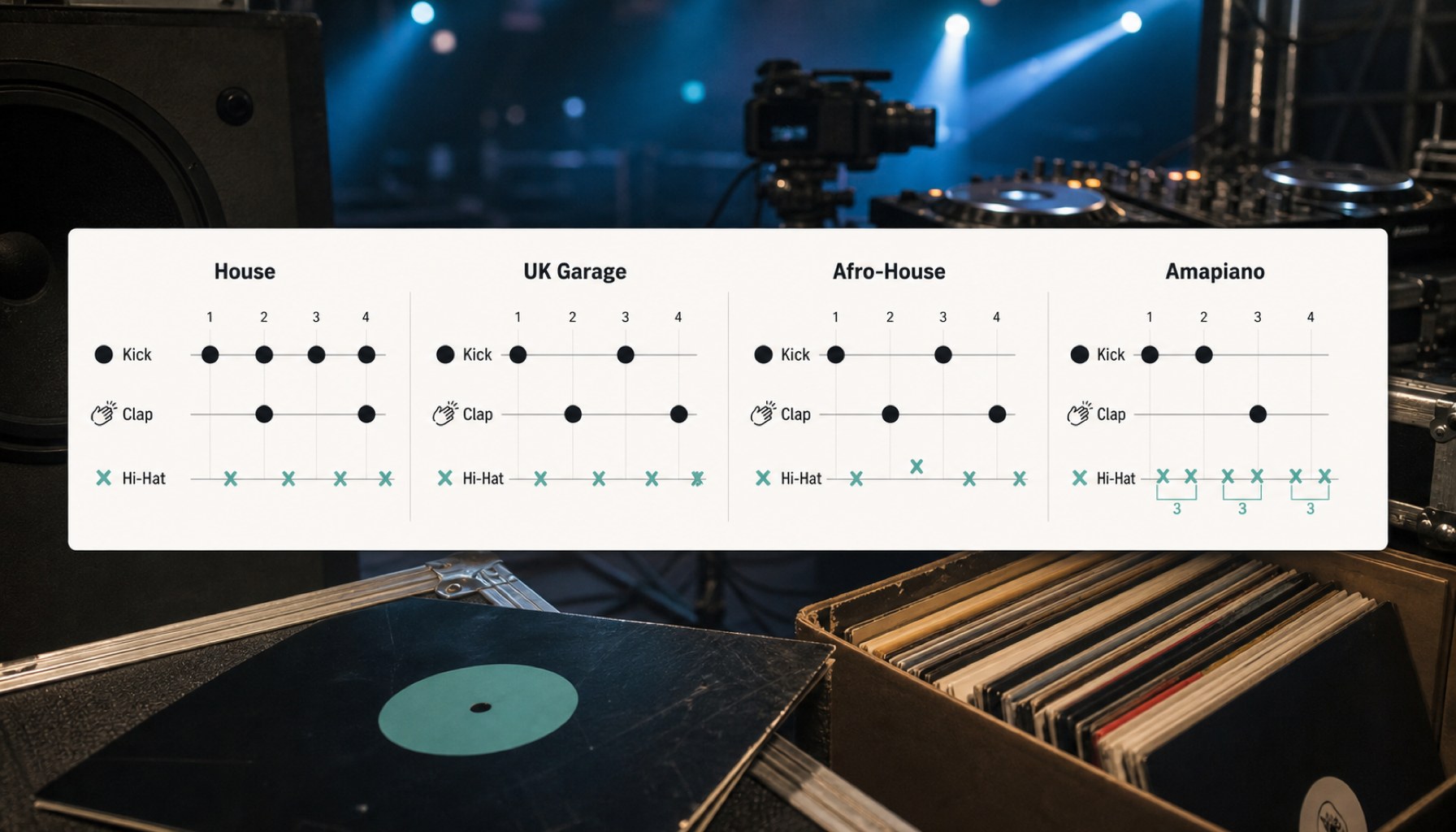
Kick on every quarter note, four-on-the-floor without deviation. Clap or snare on two and four, open hi-hat on eighth-note offbeats. This is the foundation from Daft Punk to FISHER: straight, hypnotic, ruthlessly functional.
UK Garage: the 2-step stumble (130 to 135 BPM)
Here, the kick leaves the straight grid. It sits on one and a gap, the snare on two and four, with shifted hi-hats rolling in between with strong swing. The result stumbles deliberately; this is where the drive comes from.
Afro-House: the percussive carpet (120 to 125 BPM)
Over the straight kick, a dense layer of congas, shakers, and percussion is laid in a 3-3-2 pattern. The groove rolls sideways over the beat. With Black Coffee, you hear how club tension builds without the beat having to push.
Amapiano: the log drum in the cellar (around 112 BPM)
Slower, airier, with the characteristic log drum that takes over the bassline. Wide shakers, lots of space, little pressure. How the log drum sound is technically created, we broke down step by step in the Amapiano production guide.
Once you’ve understood these four grids, the fine-tuning begins: ghost notes, swing, small pauses, longer breaks. The same blueprint you know from the arrangement from loop to track carries each of these grooves over the full song length.
What do you need before swing kicks in?
Technically the hurdle is low. Every DAW ships with a step sequencer and a drum rack, and that’s all you need. Then the swing knob decides: it turns the same samples into either a rigid grid or a groove that breathes before the beat.
Set it to zero for House and noticeably higher for Garage or Amapiano, and the beat instantly comes alive. Many beginners leave everything at 0 % swing and wonder why it sounds like a machine.
My tip when you start: pick a reference track for each genre, mute it in your project, and simply program the beat note for note. You’ll be surprised how few elements these hits actually contain. A good beat is almost always simpler than it sounds, because the space between the hits is as important as the hits themselves. If your groove lands but still feels flat, it’s rarely the sound and almost always the timing.
Q&A after the Show
Click on a question to expand the answer.
Which DAW is best suited for beats?
What’s the difference between swing and quantization?
Do I need expensive sample packs for good beats?
How do I find the right tempo for my genre?

Amapiano Production: How the Log Drum Sound is Created →EDM Arrangement: From Loop to Track with a Real Tension Arc →How a Synthesizer Works: The Four Building Blocks of Every Sound →DJ Entry: Your First Set with a Tension Arc →
Image source: Title image and article images generated by AI (June 2026), C2PA certificate embedded in the image
Translated from the German original using artificial intelligence. The German version is authoritative.