


01 Jul Car Loudspeaker Test: Which Ones Really Sound Good
▶ 6:30 min read
The speakers that come pre-installed in your car are the cheapest part of the entire system. Paper cones, no dedicated tweeters, tuned for cost rather than sound. This is where the biggest leverage lies: no streaming subscription, no expensive cables, and no DSP trickery delivers as much improvement as swapping out the cardboard in the doors. I’ve looked at what will truly make a difference in 2026 if you actually listen to music in the car-not just run podcasts in the background. Five steps, ranked by what delivers the most sound per euro.
1. Ditch the factory speakers
Car makers cut costs where buyers least expect it: the speakers. Most stock systems use paper cones without dedicated tweeters, tuned to sound “good enough” in the showroom. Once you’re used to high-end headphone sound, the difference is glaring: missing highs, lost detail, and bass that’s more thud than tune.
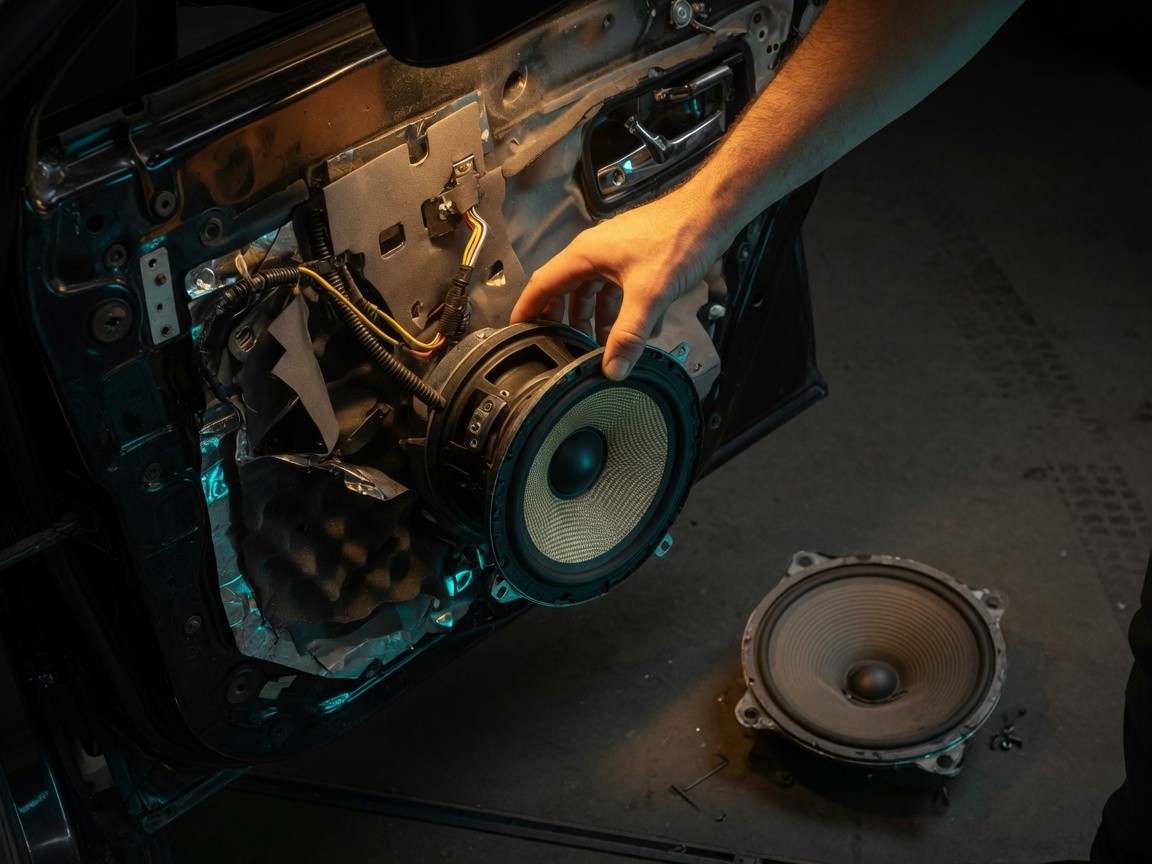
Upgrading to proper aftermarket drivers is therefore the step that delivers the most sound per euro spent. The Focal PC100 is widely hailed in 2026 as the value leader, sounding leagues ahead of anything factory-fitted. Want more? The Focal ICU165 takes the top spot with its Polyglass cone. Both are coaxial designs that drop straight into most cars’ standard speaker locations.
2. Coaxial or component: the fundamental question
This is where quick swaps diverge from genuine upgrades. A coaxial speaker combines the woofer and tweeter in a single chassis. It often fits directly into the factory location and can be installed in under an hour. A component system separates the tweeter and mid-woofer, positioning the tweeter higher up on the A-pillar or mirror. The result is a soundstage in front of you instead of emanating from the footwells.
For most drivers, a good coaxial system is the honest deal. If you truly value imaging and soundstage-and are willing to run wires-the difference in a component system is immediate. Two models delivering excellent value are the Eton POW 160.2, which boasts punchy mids, and the Hertz ESK 165, which packs extra punch in the bass.
3. The source matters more than any wattage figure
Wattage ratings on the box tell you almost nothing about the sound. What matters is the signal that actually reaches the speakers. A factory radio delivers a compressed, often already distorted signal. The next logical step is inserting a small DSP amplifier that tailors the frequency response to the cabin. That single move extracts far more from the same speakers than any brute-force power increase ever could.
Streaming quality is also part of the chain. Listening over Bluetooth with the SBC codec means you’re throwing away resolution. A cable-or a better codec like AAC-is the cheapest part of the entire upgrade. Bottom line: the most expensive speaker won’t rescue a bad signal.
4. Subwoofer only if your genre demands it
A subwoofer isn’t mandatory; it’s a genre call. If your car mostly plays hip-hop, electronic, or modern pop productions, a door-only system will lack the sub-60 Hz bass that makes tracks “go from good to blow-up.” A compact under-seat subwoofer adds the punch that turns “sounds good” into “turns heads.”
If you listen mainly to singer-songwriter, jazz, or acoustic music, you can skip the sub. A solid component system supplies enough fundamental tone for those styles. Before investing in a subwoofer, play through your playlists honestly and ask how often deep bass is actually part of the track.
5. Door insulation: the invisible amplifier
The most underestimated step costs little and delivers results instantly. A car door straight from the factory is a flimsy metal box full of holes. The speaker fights against this vibrating wall instead of directing sound forward. A few layers of insulation mat on the door panel transform the door into a stable speaker enclosure.
The outcome with the same speakers: deeper bass, clearer midrange, and less road noise. If you’ve already installed new speakers but still feel they lack punch, this is where you should start before splurging on the next expensive set.
Coaxial, Component or Full Active – a Comparison
| System | Sound | Installation | Best for |
|---|---|---|---|
| Coaxial | clearly better than factory | Plug-and-play, one hour | quick, honest first step |
| Component | true soundstage and imaging | run cables, half-day job | anyone who wants a soundstage |
| Full active with DSP | maximum, room-corrected | professional shop recommended | budget-minded enthusiasts |
Q&A after the show
Click on a question to reveal the answer.
Coaxial or component speakers for the first upgrade?
Do I need an amplifier for new speakers?
Does a subwoofer pay off for every music style?
Does door damping really make an audible difference?
[/vc_column_text][/vc_column][/vc_row]

Why your studio monitors are lying: it’s all about the room →Understanding loudness: why your master sounds quieter →Stem separation: what the AI tools can really do →
Image source: AI-generated (July 2026)
Translated from the German original using artificial intelligence. The German version is authoritative.