


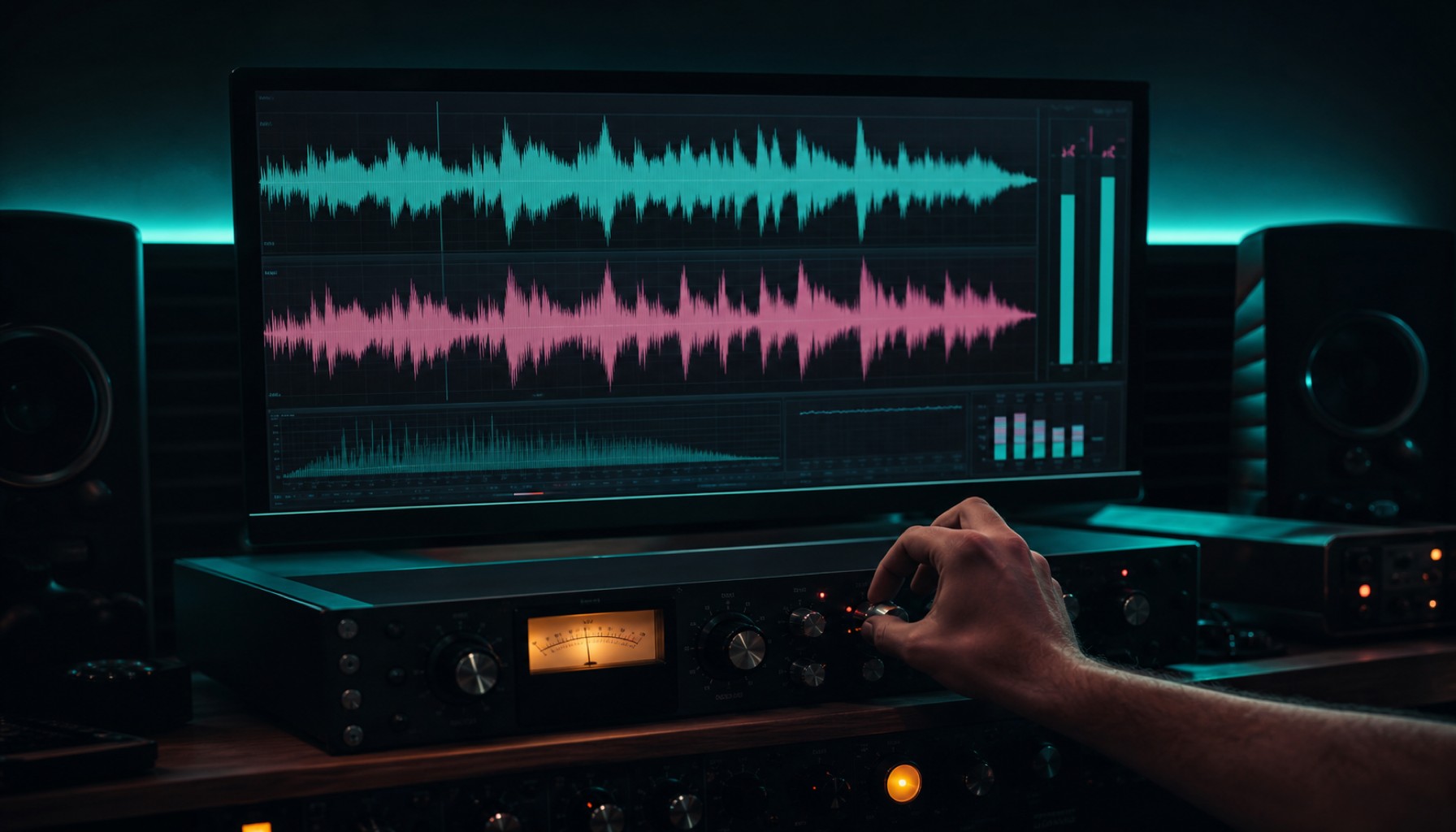
22 Jun Understanding Loudness: Why Your Master Sounds Quieter
5:45 read time
You line up your finished track next to a chart-topping hit, press play, and suddenly yours sounds smaller, flatter, and further away from the dancefloor. Your first reflex: push the limiter harder. That’s exactly where the problem begins. Loudness isn’t a single knob you can just turn up; it’s the result of countless decisions made long before the mastering stage. Once you understand LUFS and True Peak, you stop fighting against your own music.
DROP
- ▸LUFS measures loudness. This value describes how loud something actually sounds, not just the highest peak.
- ▸Streaming normalizes audio. Platforms pull everything down to a target level, so brute-force loudness no longer gives you an edge.
- ▸True Peak protects your mix. It catches inter-sample peaks that standard level meters completely miss.
- ▸Loudness starts with the arrangement. A clean, well-organized mix sounds loud without feeling squashed.
- ▸Dynamics are not the enemy. The contrast between quiet and loud is exactly what makes the loud parts hit so hard.
How LUFS Makes Loudness Measurable
For a long time, producers focused almost exclusively on peak levels: as long as the waveform reached all the way to the top, they were good. But the highest peak tells you very little about how loud a track actually sounds to the human ear. A song with lots of short peaks might look dangerously huge on a meter yet still sound tiny. This is exactly where LUFS comes in: the standard unit for perceived loudness over time.
LUFS mimics how human hearing averages out volume. An integrated LUFS reading describes the average loudness of an entire track. Only this number allows you to fairly compare two different songs. If you want to seriously control loudness, you need a LUFS meter, not a classic peak meter. Just how crucial honest level management is during the mixdown becomes clear when you look at gain staging.
Why Streaming Turns Loud Masters Down
For decades, the music industry waged a loudness war: every release had to be louder than the last, no matter the cost to dynamics. Streaming has largely ended this race. Platforms normalize playback to a target level, often around minus fourteen LUFS. If you upload a brutally loud master, the platform simply turns it down.
This means: crushing your track won’t gain you loudness on Spotify. You lose dynamics, spatiality, and punch. After normalization, an open mix often sounds bigger than a master that’s only pushing against the ceiling. So it’s not the highest LUFS value that matters, but a sound that holds up at reasonable loudness. How much your judgment depends on your listening room is explained in the article on why studio monitors lie.
True Peak: What Your Meter Doesn’t Show
A standard level meter shows digital sample values. However, it doesn’t catch every peak between those samples when the signal is later played back as an audible wave. These true peaks can exceed anything your standard meter displays. This is where distortions occur that you might easily miss in the studio and can’t fix after uploading.
That’s why experienced producers leave a small safety margin when mastering, typically capping true peak just below zero-often around minus one decibel true peak. This leaves headroom for conversion and the additional compression some streaming codecs apply. A true peak limiter at the end of the chain isn’t a luxury-it’s insurance against distortions you can’t even hear in the studio.
Louder Mixing Starts Before the Limiter
The most important truth about loudness sounds unspectacular: It happens early in the project. When kick, bass, vocals, and synths aren’t fighting for the same space, a track already sounds big before the limiter. The limiter then only sets the final edge, instead of having to rescue the entire mix.
Conversely, no limiter in the world can save a mix where everything is competing for the same frequencies. You squash it louder, but it turns muddy and lifeless. So if you want louder masters, you first work on the arrangement, clean equalizing, and separation of elements. Loudness is ultimately less a question of mastering than a question of order throughout the entire project.
Q&A After the Show
Click a question to expand the answer.
What LUFS value should I master to?
Why does my master sound distorted even though the level is fine?
Will the limiter ruin my music?
Do I need expensive metering plugins?

Editorial Team IBS Publishing ››
Gain Staging: Why Your Mix Sounds Muddy →Why Your Studio Monitors Lie: It’s the Room →Vocals in the Home Studio: How to Make Your Recordings Sound Professional →EDM Beats 2026: Four Rhythms Dominating the Charts →Field Recording: Creating Your Own Sounds from Everyday Noises →
Image source: AI-generated (June 2026)
Translated from the German original using artificial intelligence. The German version is authoritative.