


08 Jul Korg’s Mystery Synth: What’s Behind the Foil
4:30 Read Time
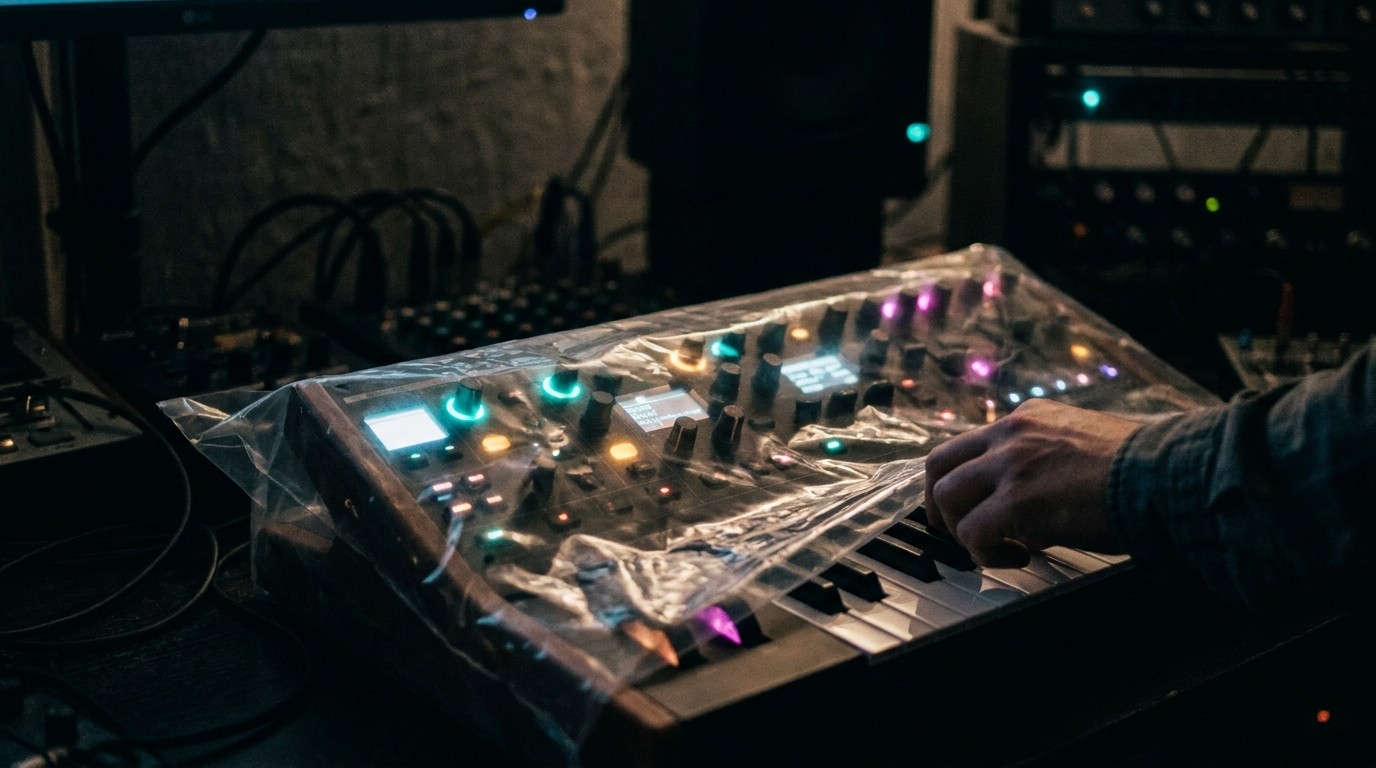
Korg unveiled a new synthesizer at Superbooth in Berlin and hid it at the same time. The prototype stood under a translucent cover for three days, five octaves of keys, a screen, a dense field of knobs. Booth staff answered not a single question about it. Not even under press embargo. Months later, the fog has barely lifted. No name, no price, no release date. That silence is the real statement. It’s worth taking apart.
DROP
- ▸Korg showed a 5-octave synth prototype at Superbooth in Berlin, completely hidden under a cover.
- ▸No name, no price, no release date, booth staff refused any information, even under embargo.
- ▸Visible were five octaves, a screen on the right, plenty of knobs, plus pitch and mod wheels and an LED field on the left.
- ▸The scene is guessing, everything from a Prologue successor to something entirely new is on the table.
- ▸The silence is no accident, it’s part of the staging.
A synth under plastic film
Superbooth is the most important trade show for synthesizers and electronic instruments, held every spring in Berlin. Anyone showing something there usually wants attention, spec sheets, demo sounds. Korg did the opposite. At the booth stood a device under matte film, visible enough to spark curiosity, covered enough to reveal nothing. Three days, no sound, no announcement.
I find moments like this fascinating because they show how much hardware today is also storytelling. A synthesizer is no longer just a box of oscillators, it’s a promise of a sound and a feeling. Korg plays exactly with that. And while everyone stared at the film, the manufacturer quietly slipped a compact performance mixer from the Nu:Tekt line into the market, almost unnoticed. One distracted from the other or made it more interesting, depending on how you look at it.
What the Panel Reveals
Even under a cover, plenty can be read off a synth. The community did exactly that. Visible were five octaves of keys, a display on the right side, a dense grid of knobs, pitch and modulation wheels, and on the left a row of LEDs that look like touch-sensitive faders. This is no pocket gadget but a full performance instrument.
Interpretations diverge. Some see a successor to the popular Prologue line, others bet on something entirely new from Korg’s experimental division. Honestly, deriving a sound architecture from a covered panel is ninety percent tea-leaf reading. An LED fader array points to performative control, more can’t seriously be claimed. Anyone telling you how this thing sounds right now is guessing.
Still, the visible layout says something about the target audience. Five octaves plus pitch and mod wheels are a clear commitment to playing with your hands, not programming through menus. The screen on the right suggests preset management or modulation visualization, the dense control field points to direct access without submenus. This is the language of an instrument meant to work on stage, not just in the studio. To me, that’s the most telling clue: Korg is aiming at people who play live, not pure knob-twiddlers. Whether the sound delivers on that is a different question.
What really itches for me as a gear nerd: a new panel layout is never just cosmetic. Every knob that makes it onto the final unit has won a fight against the red pen. If Korg shows five octaves and a full control surface instead of the compact formats of recent years, that’s a bet on musicians who have the space and budget for a statement instrument. These exact decisions often reveal more about a manufacturer’s ambition than any press release.
Why Korg Stays Silent
The most interesting part is the refusal itself. A manufacturer that won’t even talk under embargo sends a clear signal: we’re not ready yet. We want to keep control of the narrative. That has advantages. The speculation keeps the device in conversation for months without Korg having to deliver a finished product. Every forum thread, every panel photo is free reach.
But there’s a flip side too. Teasing too long risks fatigue. The synth world has a long memory for announcements that fizzle out. A covered panel is a promise. Promises have an expiration date. If nothing concrete arrives in the coming months, curiosity quickly tips into a shrug. Korg is playing with its own reputation here. So far it’s working because the brand has credit.
What This Means For You
In concrete terms, if you’re a musician or producer, this means one thing for now: wait. There’s nothing to buy, nothing to preorder, no reliable sound sample. If you’re already in the market for a new main synth, don’t let this dictate your purchase decision. The current Korg models and the strong competition at the show, from a new analog poly to smart grooveboxes, are real and available today.
My pragmatic advice: enjoy the rumor mill, but don’t make a decision based on a photo under plastic wrap. If Korg delivers, you’ll still have plenty of time to react. And if not, you won’t have bet your money on a phantom. Anticipation is free, but disappointment over an overhyped product costs you nerves.
Q&A After the Show
Click a question to expand the answer.
When and where did Korg show the prototype?
Do we know what the synth sounds like?
Is this a successor to the Prologue series?
Should I wait before buying a synth?

Editorial Team IBS Publishing ››
DJ Controller Tested: Pioneer DDJ-FLX10 vs. Denon Prime 4+ →Fred again.. 2026: Why the Post-Electronic Sound Is Going Mainstream Now →Streaming Economics 2026: How Spotify, Apple Music and Amazon Music Are Redistributing Royalties →Music Industry Q1 2026: Universal, Warner and Sony Report Their Numbers →
Image source: AI-generated (July 2026)
Translated from the German original using artificial intelligence. The German version is authoritative.