



06 Jun Streaming Mastering: Why Louder on Spotify Doesn’t Help
6:10 Reading time
You mastered your track to -8 LUFS so it really slams? On Spotify you won’t hear a thing from it. The platform simply turns it down again. Streaming services today normalize every playback to a fixed loudness value, and that completely changes the rules for mastering. Anyone who ignores this wastes dynamics for a loudness advantage that hasn’t existed for years. These five rules determine whether your master stays clean on Spotify, YouTube and Apple Music.
1. What Loudness Normalization Really Does
Every major streaming service measures how loud your recording sounds on average. The scale is called LUFS, Loudness Units relative to Full Scale, and follows the international standard ITU-R BS.1770. If your track exceeds the platform’s target value, it is turned down during playback. If it falls below, some services raise it.
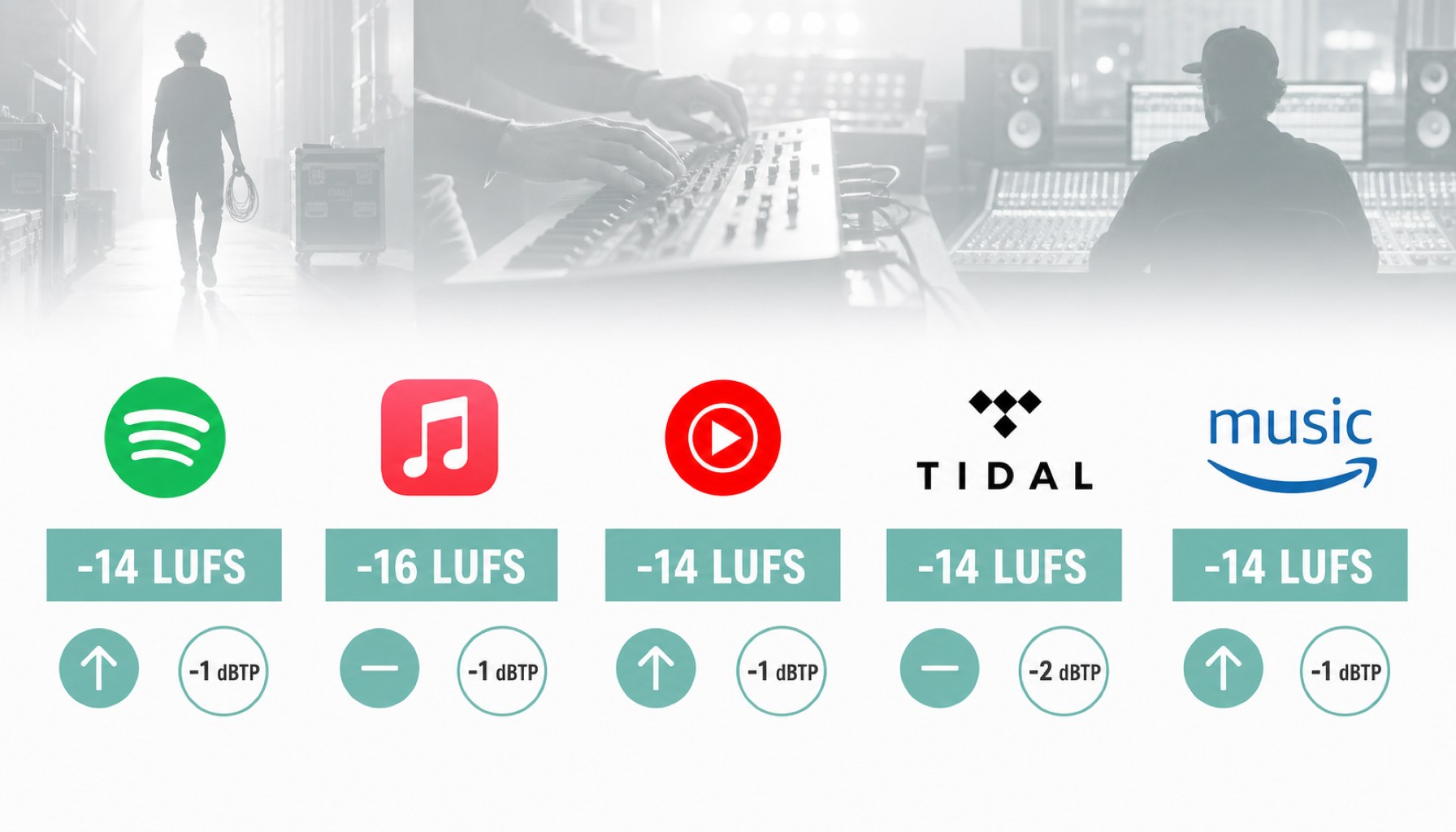
The result: All songs reach the listener at roughly the same loudness level. That is exactly what ended the Loudness War. For years people mastered louder and louder because louder sounded better in direct comparison. On a normalized platform this trick no longer works. Loudness no longer provides an edge there. What matters is how much punch remains after normalization.
2. Which Target Values the Platforms Set
The target values differ, and they do not behave the same way with quiet masters. Spotify, Tidal and Apple Music raise a track that is too quiet up to their target. Apple even does this without an additional limiter, so the dynamic character is preserved. YouTube and Amazon do not raise it; a quiet master stays quiet there.
| Platform | Target Loudness | Raises quiet masters? | True Peak Recommendation |
|---|---|---|---|
| Spotify | -14 LUFS | Yes | -1 dBTP |
| Apple Music | -16 LUFS | Yes, without limiter | -1 dBTP |
| YouTube Music | -14 LUFS | No | -1 dBTP |
| Tidal | -14 LUFS | Yes | -1 dBTP |
| Amazon Music | -14 LUFS | No | -2 dBTP |
For practical purposes this means: A master sitting at around -14 LUFS with some headroom works well across all platforms. The strictest requirement comes from Amazon with -2 dBTP. Anyone who wants to stay clean there plans the level more conservatively from the outset.
3. Why Loud Mastering Punishes You Today
Imagine two versions of the same song. One is pushed hard to -8 LUFS, the other breathes at -14 LUFS. On Spotify both end up at -14 because the loud version gets turned down. Same perceived loudness, but the squashed version has already lost its transients and its dynamics in the studio.
So you pay twice: less dynamics and a higher risk of audible artifacts, without a single advantage in volume. The only place where a loud master still stands out is the direct comparison without normalization, for example in an unregulated download. For everyday streaming that is irrelevant.
4. True Peak: The Headroom You Need
Loudness is only half the story. The second value is True Peak, the actual peak level that arises during playback. When your master is encoded with lossy compression, for example in Ogg Vorbis or AAC, small overshoots occur between the samples. If your level sits too close to zero, these peaks clip and the codec distorts.
That is why a ceiling of -1 dBTP is the safe choice across almost all platforms. Amazon Music goes one step further with -2 dBTP. An honest True Peak limiter at the end of the chain costs you practically nothing in loudness, but protects you from exactly the artifacts that make an otherwise clean master sound cheap.
5. How to Master for Streaming
The good news: You do not need to create a separate master for each platform. A single, well-executed master covers them all. Target roughly -14 LUFS integrated, True Peak at -1 dBTP, and the rest follows the song instead of a number. A ballad can be quieter and more dynamic than a club track; that is not a mistake, but music.
Trust reference tracks from your genre rather than the loudness meter alone. Load commercial songs you love into your DAW and compare dynamics and sound, not just the level. And keep album normalization in mind: Spotify, Apple Music and Tidal take the loudest track as the anchor so that the loudness relationships within an album are preserved. Anyone who keeps this in mind masters not against the platform, but with it.
Q&A After the Show
Click on a question to reveal the answer.
Should I master at -14 LUFS for streaming?
Does my track then sound quieter on Spotify than the competition?
What is the difference between LUFS and True Peak?
Do I need a separate master for each platform?

IBS Publishing Editorial ››
Mastering for Vinyl: Why the Record Sounds Different Than the Stream →Sidechain Compression: How to Build the Pump Effect Cleanly Into Your Mix →How a Synthesizer Works: The Four Building Blocks of Every Sound →Streaming Royalties: What Actually Reaches the Artist Per Stream →DJ Entry: How to Build Your First Set with Tension Arc →
Image source: Title image and article images AI-generated (May 2026), C2PA certificate embedded in the image